
A Smarter Way to Understand Stock Market Risk
Many investors fear losing their hard-earned savings — and for good reason. Putting $1,000 into the stock market can feel like gambling, with the potential for major gains or painful losses within a year. However, viewing investing as a slot machine oversimplifies the real dynamics of stock market risk.

Many investors fear losing their hard-earned savings — and for good reason. Putting $1,000 into the stock market can feel like gambling, with the potential for major gains or painful losses within a year. However, viewing investing as a slot machine oversimplifies the real dynamics of stock market risk.
True investing success comes from understanding volatility, long-term trends, and market psychology. By adopting a more strategic mindset, investors can better navigate uncertainty and make smarter decisions about risk and reward.

This is good in that, yes, for the short-term the stock market is risky. Don’t put money you may need right away into stocks. However, when young people tell me that they are putting their Roth IRAs in a bank CD because they are afraid of the stock market, that is bad. Roth IRAs are long-term investments. We’re talking 30, 40, 60 years for some people! The way you should be looking at the stock market is this:
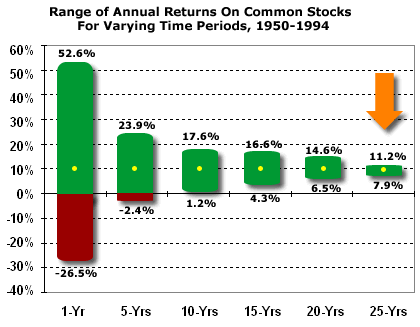
As you can see, as your time-horizon lengthens, your risk of losing money decreases significantly. When looking back and taking any 25-year period between 1950 and 1994, the worse case still gave you a 7.9% annualized return. Note that the average for all of these time periods is still the same, 10% per year. So what you’re really looking at is something more like:

Although we may not get that same 10% average in the future, I think it’s clear that you need to make your horizon as long as possible by starting now. Remember, even though you may track your investments daily, most of you are not going to actually touch them for decades, so it doesn’t matter what happens next year. What matters is that you were “in the game” for that year, extending your time period in the market, rocky or not. Also, this is just stocks – We are not even taking into the account the additional tempering effect of incorporating bonds to your portfolio.
Finally, consider this. Right now, bank CDs paying 6% in some cases may seem nice. But after inflation, the long-term return of cash-equivalents like bank accounts or Treasury Bills is… zero. By not investing in stocks (again, for long periods), you are giving yourself a 100% chance of making nothing. IRAs, 401ks, 403bs, TSPs, they are all for the long-run. Get in the game!
* The graph is adapted from one in A Random Walk Down Wall Street by Malkiel, one of my recommended investing books. Common stocks are defined as a diversified stock portfolio, such as the S&P 500 Index.












还有节点分享的渠道嘛多谢